Apple Stock Price Forecast 2026 to 2030: Here is latest AAPL news

New York, 23 January 2026: Apple Inc. (NASDAQ: AAPL) is the world’s most valuable tech company, earning billions of dollars from the iPhone, iPad, Mac and its services business. As of 23 January 2026, the company’s market value is around $3.6 trillion. In this article, we’ll look at AAPL stock price forecast from 2026 to 2030, predictions from US stock market analysts, the company’s pros and cons, future plans, total returns for investors, and the impact of US government policies on Apple’s products and services. This analysis is based on various sources and, considering market volatility, is just indicative.
Apple Stock Price Forecast 2026 to 2030
To estimate Apple’s stock price, we used various models and historical data. By 2026, the stock price could reach around $260 to $300, influenced by AI integration and new products. By 2030, the price could go up to $350 to $550, factoring in the growth of the services business and new markets. The table below gives the yearly estimates:
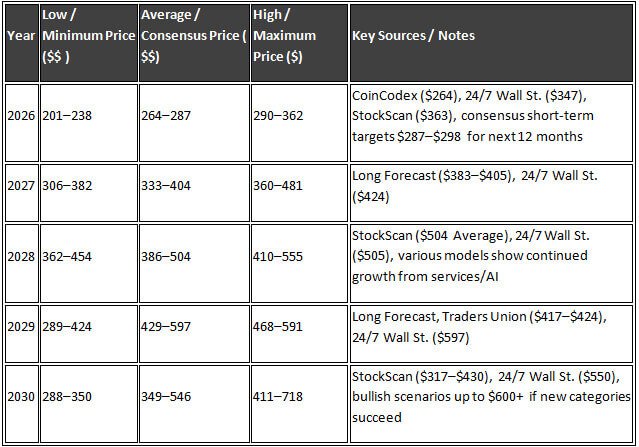
This estimate is based on AI, the foldable iPhone and service growth. However, market risks like rising interest rates and global supply chain issues could have an impact.
American stock market analysts apple stock price predictions 2026 to 2030
According to American analysts, Apple’s stock is positive with a “buy” rating. The average 12-month target is $293, with an expected increase of 18%. For 2026, analysts predict between $287 and $350. For 2030, forecasts range from $350 to $520, influenced by new products and AI integration. Opinions of key analysts:
- UBS: $280 (neutral)
- Evercore ISI: $315 to $330
- Citi: $315
- Goldman Sachs: Buy Dip
- 24/7 Wall Street: $660 by 2030
Analysts think that Apple’s services and AI growth will keep the stock strong, but there are risks from regulatory issues and tariffs.
The pros and cons of Apple Inc.
Apple is a strong brand, but there are both pros and cons to its ecosystem.
Pros
- Seamless integration: Apple products (iPhone, Mac, iPad) connect with each other easily, making the user experience awesome.
- Privacy and security: Apple prioritizes user data protection, which reduces the risk of malware and hacking.
- Great brand and innovation: High-quality products and new technologies like AI and foldable devices are making its place in the market strong
- High resale value: Apple products don’t lose their value.
- Excellent customer service: support available 24/7
Cons
- High price: Products are expensive, which makes them unaffordable for ordinary people.
- Closed ecosystem: Limited compatibility with other companies’ products, which reduces flexibility.
- Limited customization: users can’t make changes to products
- Supply chain problems: relying on China affects political instability.
- Environment and labor issues: Criticism on workers’ rights and environmental matters in the supply chain.
Apple Inc.’s plans
Apple is planning big changes in 2026. The company will invest over $500 billion in the US, creating 20,000 new jobs. Key plans:
- Expansion of production in the US: a new factory in Texas, server production in Houston and a production academy in Michigan.
- New products: Foldable iPhone (7.8-inch display), AI glasses, smart home devices, OLED iPad and budget MacBook.
- AI and Silicon: Apple Intelligence expands, new iPad Air with M4 chip and smart Siri in iOS 26.4.
- Environmental goal: Increase renewable energy and recycling.
- Market expansion: Production is increasing in India and Vietnam.
Total return Apple Inc. has given to investors
Apple has historically given investors excellent returns. A $10,000 investment since 1980 is now worth $252,288,210 (18.96% annual return). Key figures:
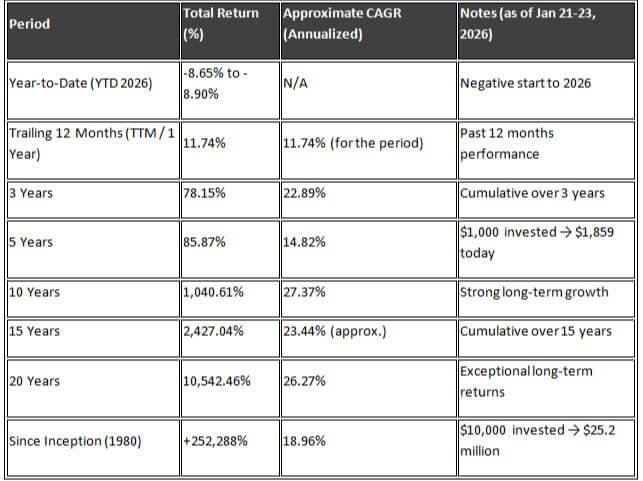
9.05% return in 2025, while 30.71% in 2024. Returns increase due to dividend reinvestment.
Impact of American government policies on Apple’s products and services
The American government’s policies have a big impact on Apple. Key points:
- Antitrust case: The DOJ has accused Apple of monopoly, covering the iPhone ecosystem, the App Store and cross-platform messaging. This could lead to changes in products.
- Tariffs and trade war: Trump’s tariffs (34% on China, 32% on Taiwan) are affecting the supply chain, which could raise prices and increase production costs. Apple is boosting investment in the US ($600 billion).
- Privacy and security: In the FBI vs Apple case, there was a dispute over encryption. The government wants the data, but Apple protects privacy.
- Lobbing: Apple spends $9.9 million on lobbying, which includes tax, data and copyright issues.
- Environment and labor policies: Because of American policies, Apple has to improve environmental and labor rights.
These policies are forcing Apple to increase production in the US, but the global supply chain gets affected.
Conclusion
Apple Inc. is a strong company, and growth is expected in the future due to AI and new products. However, regulatory and trade policies pose risks. Investors should keep an eye on market changes. This article is informative; contact experts for professional advice.
Related Articles