
Daylight Saving Time 2026 in the United States : What’s happening in USA?

New York, 22 December 2025 : Daylight Saving Time (DST) is a practice observed in many countries, particularly in the United States. Its purpose is to make the most of daylight hours, thereby saving energy and making daily life more efficient. In the United States, DST has a history dating back over a century, and it is likely to continue in 2026 as well. This article provides a detailed discussion on the concept of DST, its history, specific dates for 2026, effects, controversies, and the current status. As of the current date (27 November 2025), no concrete announcement has been made regarding changes to DST rules in 2026, so traditional dates will remain applicable.
What is daylight savings time?
Daylight Saving Time is a temporary practice of changing the time in which clocks are set forward to provide more daylight in the evening. In the United States, DST begins every year in March and ends in November. During this period, sunrise occurs later in the morning, but sunset happens later in the evening. This is particularly useful in summer when days are longer. The main objective of DST is to save energy, such as reducing electricity consumption, as people remain awake longer in the evening and make use of natural light.
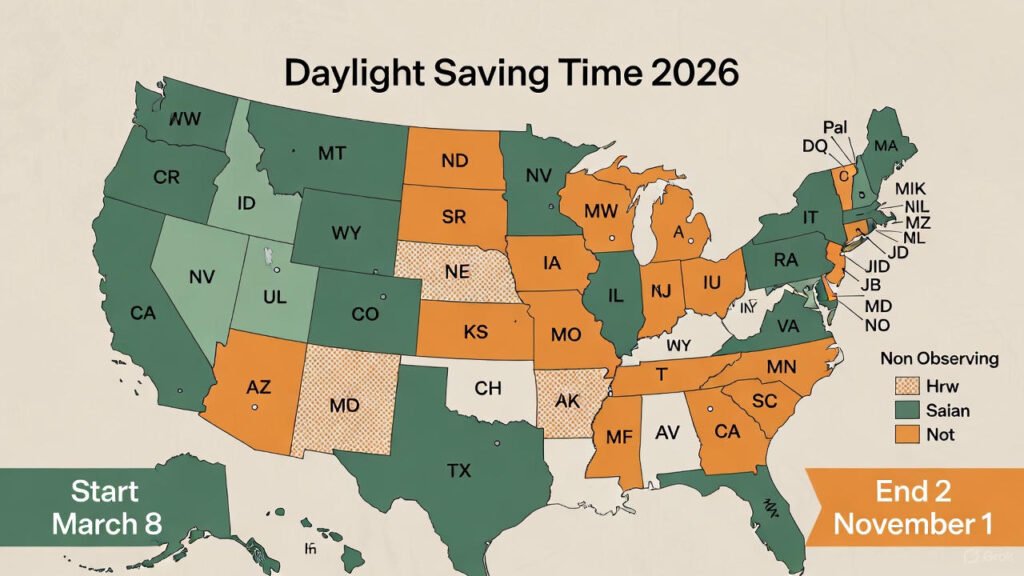
Most states in the United States observe DST, but there are a few exceptions, such as Hawaii and Arizona (excluding the Navajo Nation), which never implement DST. The rules for DST have been determined since 2007 according to the Energy Policy Act, commencing on the second Sunday of March and ending on the first Sunday of November.
Daylight Savings 2026
The concept of DST was first proposed in 1908 by George Vernon Hudson in New Zealand, but it was first implemented in the United States in 1918 during the First World War. At that time, clocks were moved forward in March and back in October under the Wartime Act. This practice continued during the Second World War, but in the post-war period, it became irregular. Various states implemented DST independently, causing confusion.
In 1966, the Uniform Time Act introduced uniform rules for DST. In 2005, the Energy Policy Act moved the start date from the first Sunday in April to the second Sunday in March, extending the duration of DST by two weeks. Today, the DST period lasts for nearly 8 months, which is more than 4 months of the year.
When is daylight savings 2026
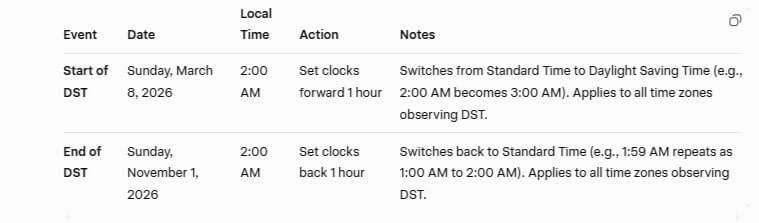
The start and end of DST in the United States in 2026 will be as follows:
Start: 8 March 2026, at 2:00 AM. At this time, clocks will be set forward by one hour (Spring Forward). This will result in darker mornings, but there will be more daylight in the evenings.
End: 1 November 2026, at 2:00 AM. Clocks will be set back one hour (Fall Back). This will cause the sunrise to occur earlier in the morning, but it will get dark earlier in the evening.
These dates are according to traditional rules, which include the second Sunday of March and the first Sunday of November. These changes temporarily affect travel, work, and health, which is referred to as ‘social jetlag’.
When is daylight savings time 2026
Effects of DST
Positive outcome
Energy conservation: Studies indicate that DST reduces electricity consumption by 1%, particularly due to savings in vehicle fuel.
Economy: Longer daylight hours benefit the retail, tourism, and fitness sectors. For example, more players visit golf courses.
Road safety: Accidents decrease by 7% in the evening due to increased lighting.
Negative outcome
Health: Changing the time disrupts sleep patterns, which increases the risk of heart disease, stroke, and accidents. The American Academy of Sleep Medicine is opposed to DST.
Agriculture and education: The morning darkness creates problems for farmers and students.
The human body operates according to sunlight. Changing the time due to DST creates a mismatch between the body’s internal clock and the external environment, which is called ‘social jetlag.’ This occurs particularly during the spring forward (in March), when one hour of sleep is lost. As a result, hormones (such as melatonin and cortisol) are disrupted, leading to increased stress and health risks. Studies show that this effect lasts for a few days or weeks, and is more pronounced in some people (particularly the elderly and those with heart conditions).
Confusion: Coordinating time for international travel and companies becomes difficult.
Daylight saving time clocks 2026
Debate and current situation
There are always debates about DST. Some people prefer permanent standard time, while others favour permanent DST. In 2022, the Sunshine Protection Act attempted to implement permanent DST, but it stalled in the Senate. In 2025, this bill was reintroduced as S.29 (Senate) and H.R.139 (House), but on 28 October 2025, Senator Tom Cotton blocked it. Currently, it is in the initial stages and is unlikely to be implemented by 2026.
Many states, such as Florida and California, are attempting permanent DST, but federal approval is required. Public opinion polls indicate that 65% of Americans support ending DST.
1. Sleep problems and disruption of the circadian rhythm
- At the beginning of DST, one hour of sleep is lost, which leads to fatigue, reduced concentration, and increased weakness.
- Over time, a late morning sunrise disrupts the body’s natural waking cycle.
Study: According to the Sleep Foundation, DST increases sleep disorders, leading to a 10-20% rise in mood disturbances and suicide risk.
2. Heart and vascular problems
- The risk of heart attack increases by 6-30% after the spring forward, particularly during the first week.
- The incidence of stroke and hospitalization is increasing. NIH studies have found that DST is associated with heart disease, stroke, and blood pressure problems.
A PMC study identified four major risks: heart disease, injury, mental disorders, and behavioral problems.
3. Impact on Mental Health
- Depression, anxiety and Seasonal Affective Disorder (SAD) increase as reduced morning light disrupts mood hormones.
- According to Harvard Health, DST increases mental stress and the likelihood of suicide.
4. Accidents and Other Hazards
- Traffic accidents increase by 6-11% because reaction time decreases due to lack of sleep.
- Injuries and workplace accidents increase. According to the CDC, DST increases the risk of heart disease by 30% and raises the mortality rate.
5. Other long-term outcomes
- Metabolic disorders, weight gain, risk of diabetes, and stroke.
- A 2025 study found that DST increases the risk of obesity and stroke, recommending the permanent adoption of standard time.
Positive health outcomes
Some positive effects of DST are also mentioned, such as increased exercise and improved mood due to more evening light. However, scientific studies consider these benefits negligible and negative effects more substantial. For example, the Johns Hopkins study noted that immediate risks are higher.
Scientific study and the current situation
AASM Position Statement (2021): Negative impact on health and safety due to DST, recommendation for standard time.
PMC study (2020): Clusters of heart disease and wounds were found after DST transition.
Duke University study (2025): Claims that heart attacks are not triggered, but other effects persist.
Virginia Tech (2025): Due to DST, morning light decreases, disrupting the biological clock.
Efforts are underway to end DST in America, as 63% of people prefer standard time.
When does daylight savings time start 2026
In 2026, the start of Daylight Saving Time (DST) in the United States will be at 2:00 AM on 8 March 2026. At this time, clocks will be moved forward by one hour (Spring Forward). This follows the traditional rules, which include the second Sunday of March. Currently, no changes have been announced.
When does daylight savings end 2026 : When does daylight savings time end 2026
In 2026, the end of Daylight Saving Time (DST) in the United States will be at 2:00 AM on 1 November 2026. At this time, clocks will be set back by one hour (Fall Back). This is according to the traditional rules, which include the first Sunday of November. Currently, no changes have been announced.
When does daylight savings time 2026 end permanently?
In 2026, the end of Daylight Saving Time (DST) in the United States will occur on 1 November 2026 at 2:00 a.m. At this time, clocks will be set back by one hour (Fall Back). No law has yet been enacted for a permanent end; although discussions are ongoing in Congress, the traditional rules will remain in effect until 2026.
Conclusion
In 2026, DST will remain a part of daily life in the United States, despite ongoing debates. The period, which begins on 8 March and runs until 1 November, is important for energy savings and economic benefits, but it affects health and convenience. Legal changes may occur in the future, but for now, the traditional rules remain. If you are in the United States, prepare to adjust your clocks and enjoy the benefits of DST.